Liquid Nitrogen Flash Freezing: How Cryogenic Freezing Works, What It Costs, and When a Blast Freezer Is Enough
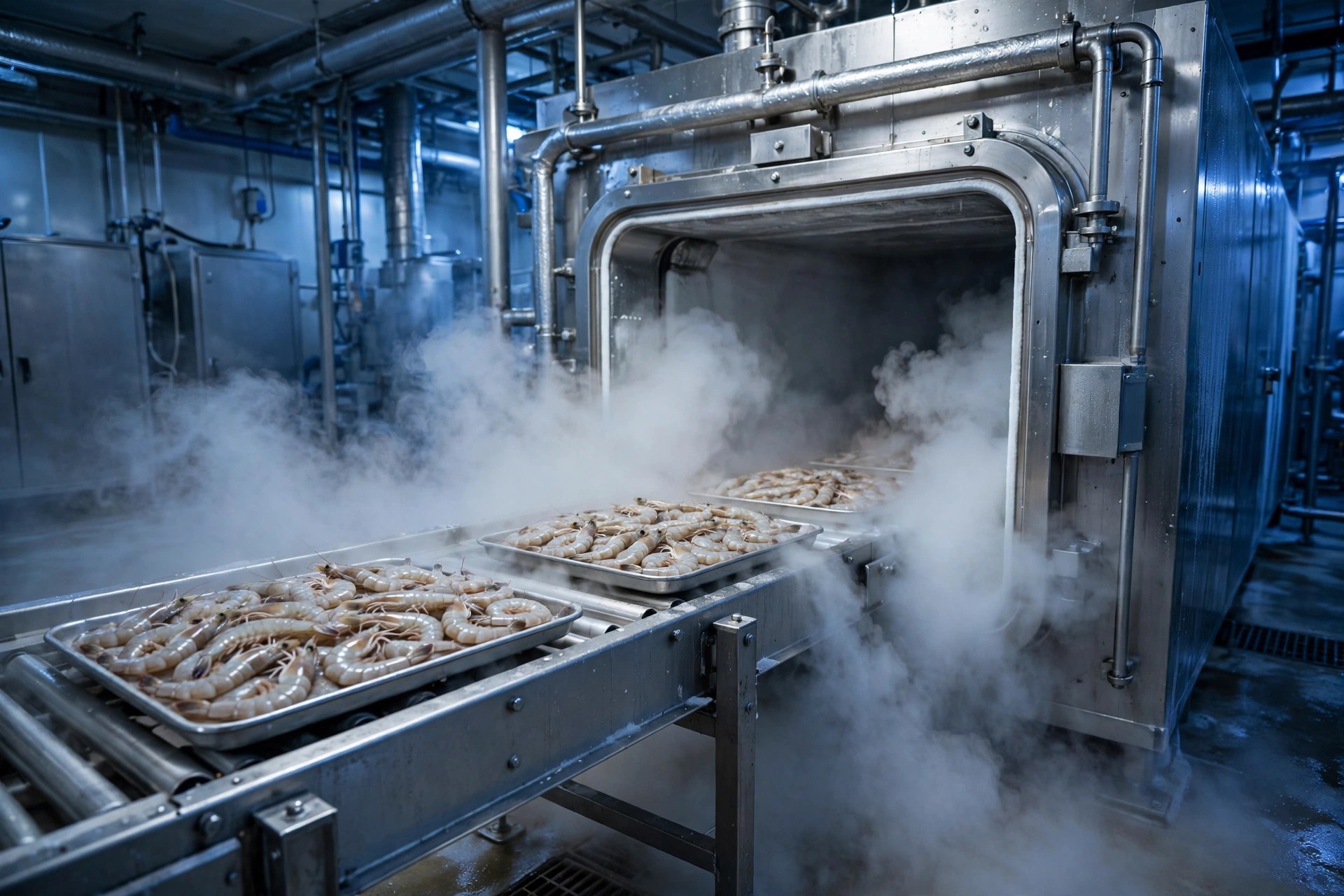
Liquid nitrogen (LN2) freezing — also called cryogenic freezing — is having a moment in the cold chain, and for once the hype has physics behind it. Food processors use it to freeze shrimp, berries, premium meats and ready meals in minutes instead of the better part of an hour. If you run a food business in Ontario and keep seeing the term, here is what it is, what it costs, and — just as important — what it does not replace.
How liquid nitrogen freezing works
Liquid nitrogen boils at −196°C (−320°F). In a cryogenic tunnel freezer, product rides a conveyor through a chamber where LN2 is sprayed or circulated as a gas; the nitrogen absorbs heat as it warms and vaporises, pulling the product's core down to −18°C in roughly 2–8 minutes. A mechanical blast freezer, working at around −35 to −40°C, typically needs 20–60 minutes for the same job. Cryogenic freezing is, in other words, about 5–10 times faster — and there is no compressor or condenser in the freezer itself; the cold arrives in a tank truck.
Why speed is quality: the ice-crystal zone
As food freezes, it passes through a critical zone between 0°C and −5°C where ice crystals form. Move through that zone slowly and a few large crystals grow, spearing cell walls; on thawing, the product weeps — drip loss — and eats soft and dull. Blast through it at cryogenic speed and thousands of tiny crystals form instead, leaving cells intact. The measurable result: frozen product with roughly 30–50% less drip loss than blast-frozen equivalents, better texture, colour and flavour, and more of the weight you froze still there when it thaws. This is also what makes IQF (individually quick frozen) possible: a fast crust-freeze on each piece keeps shrimp, berries and diced vegetables free-flowing instead of clumped into a block.
What it costs: the honest arithmetic
- Consumption: modern cryogenic systems use roughly 1.0–1.2 kg of liquid nitrogen per kilogram of product frozen. LN2 is a consumable you buy forever — there is no machine to pay off and stop paying.
- Capital: the tunnel itself is comparatively simple (no refrigeration plant), so entry cost is lower than an equivalent mechanical line — the spending moves from capex to operating cost.
- Where it pays: high-value, quality-sensitive product — seafood and prawns, berries and soft fruit, premium meats, ready meals, ice cream novelties — where a few points of yield and a better thawed product are worth real money.
- Where it usually doesn't: bulk commodity freezing and long-term storage, where mechanical freezing at a fraction of the running cost does the same job.
Cryogenic vs blast vs cold room: three different jobs
| LN2 / cryogenic tunnel | Mechanical blast freezer | Walk-in storage freezer | |
|---|---|---|---|
| Working temperature | −196°C (nitrogen) | ≈ −35 to −40°C | −18°C or colder |
| Job | Freeze product in minutes | Freeze product in under an hour | Hold frozen product for weeks–months |
| Typical time | 2–8 minutes through the tunnel | 20–60 minutes per batch | Continuous storage |
| Main cost | LN2 consumption per kg | Electricity + equipment | Electricity + the room itself |
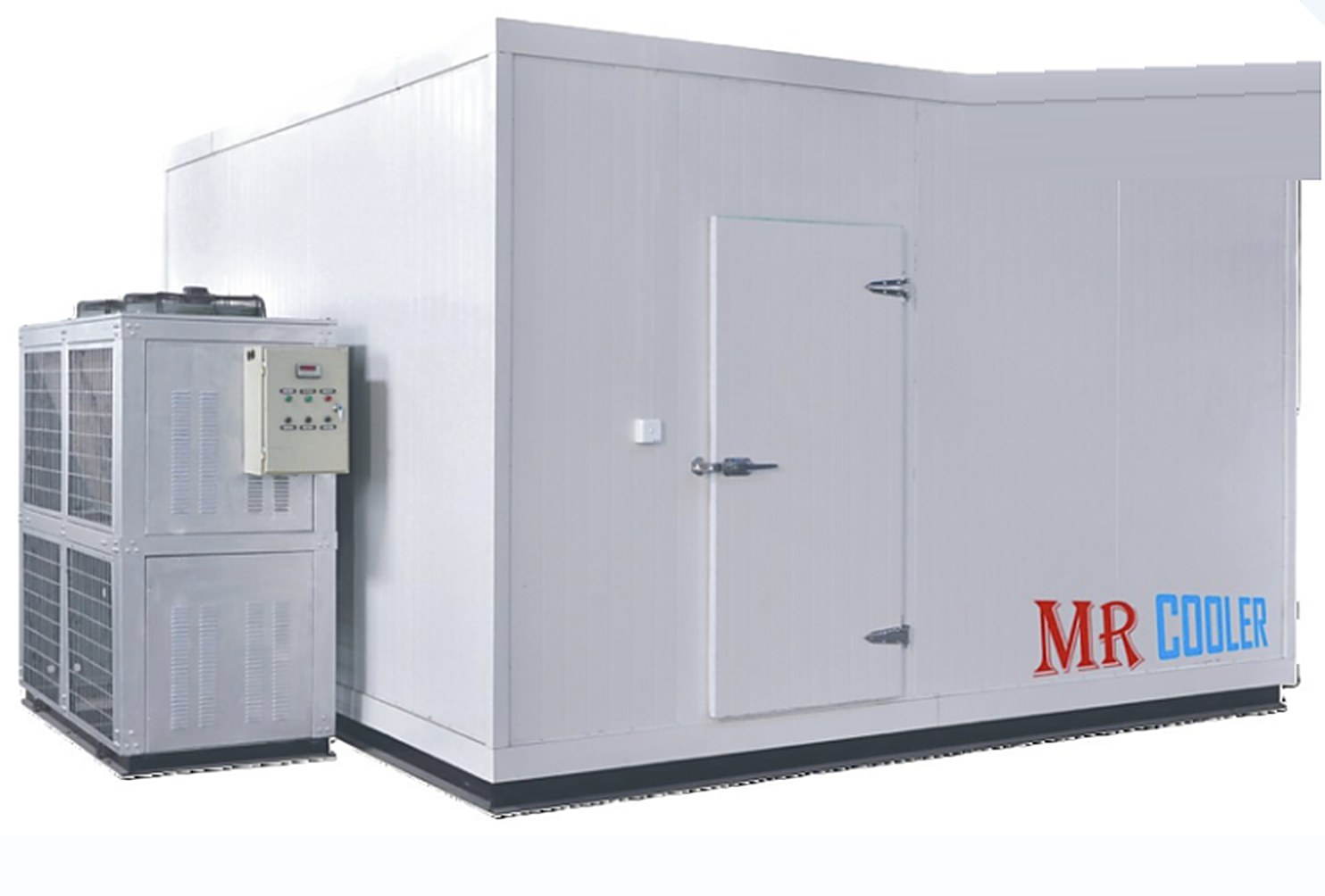
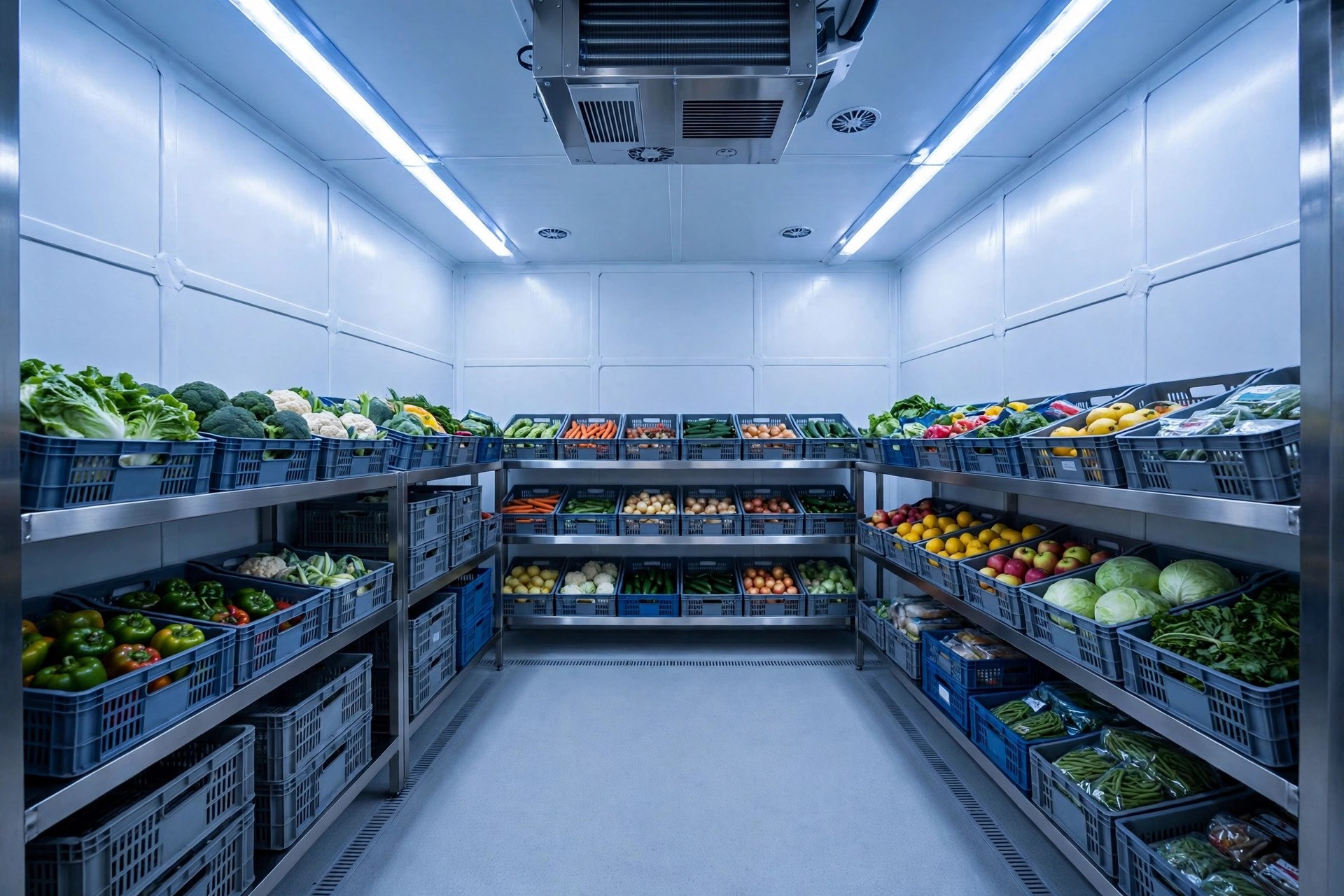
The comparison that matters: these are not competitors, they are consecutive steps. Even the most advanced cryogenic line in the world discharges frozen product that must immediately go somewhere held at −18°C or colder — a walk-in storage freezer — and stay there, monitored, until it ships. Freezing fast protects quality; storing stable protects everything after.
Safety: the part nobody should skip
Liquid nitrogen is a serious industrial material. One litre expands to roughly 694 litres of gas, and nitrogen silently displaces oxygen — a leak in a closed room can asphyxiate without any smell or warning. Proper installations require ventilation and oxygen-depletion alarms, cold-burn PPE (insulated gloves, face protection) for anyone handling connections, and food-grade nitrogen (≥99.9% purity) for anything touching product. None of this is a reason to avoid the technology — processors run it safely every day — but it belongs in the budget and the floor plan from day one, not as an afterthought.
So — do you need it?
If you freeze delicate, high-value product and sell on quality after thawing, liquid nitrogen freezing deserves a serious look, ideally with a trial run on your own product before any commitment. If you freeze sturdy product in bulk, a mechanical blast freezer is usually the economical answer. Either way, plan the whole chain: the freezer that freezes is only half the system. The room that stores — sized right, sealed right, and watched around the clock so a silent failure never takes a season of product with it — is the other half, and it is the half we build.
Frozen fast is step one — stored stable is step two
However product is frozen, it still needs weeks or months at a steady −18°C or colder. 51 Cooler builds the walk-in freezers that hold the second half of the chain — and monitors them around the clock.